
- Written by: Arni-OC
- November 17, 2026
- Comments: (0)
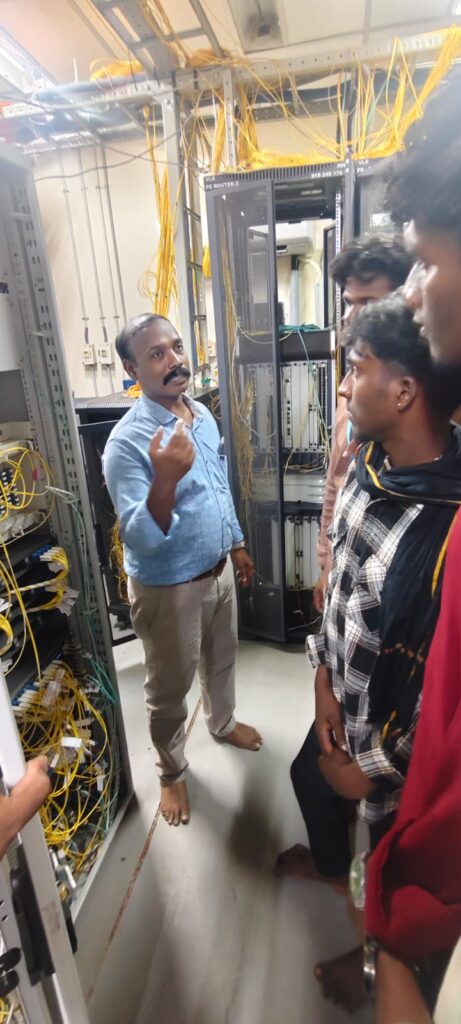
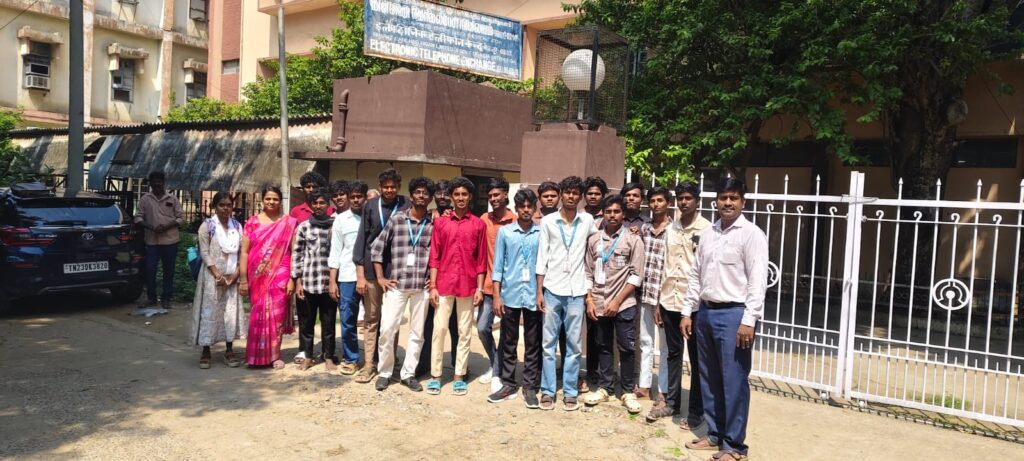
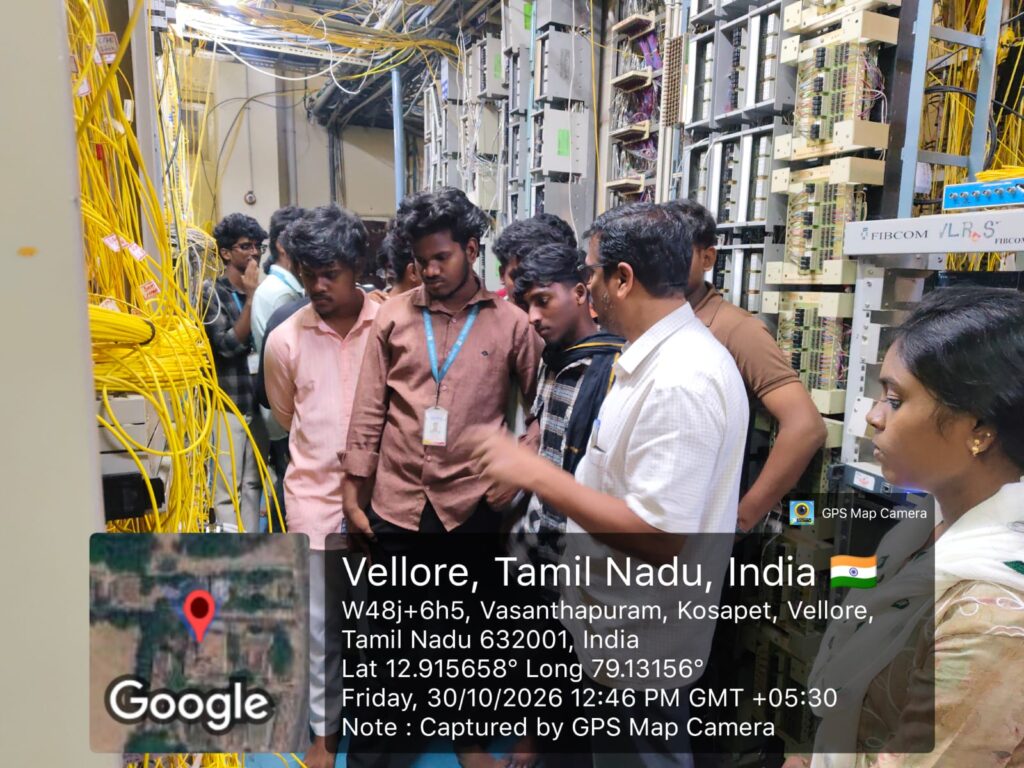
On Friday, 30 October 2026, 18 students from the Department of Electronics and Communication Engineering, accompanied by Class In-charge Dr. D. Jaipriya and Lab Assistant Mr. S. Gopi, visited the Bharat Sanchar Nigam Limited (BSNL) premises at Vasanthapuram Road, Kosapet, Vellore. The visit was organised to connect classroom concepts in telecommunications, networking, power systems, and information security with real-world infrastructure. BSNL staff explained how the local telephone exchange acts as a central concentration and control point, connecting subscribers in Vellore and nearby towns to statewide, national, and international networks through a layered architecture comprising customer access links, high-capacity optical fibre aggregation and transmission lines, and core routing nodes arranged in resilient ring, star, and mesh topologies. Observing the physical facility—including equipment racks, distribution frames, and optical fibre patch cords—highlighted the importance of structured cable management, connector cleanliness, and accurate circuit labelling. A major technical highlight of the visit was the facility’s dedicated power architecture, where incoming AC power (explained as approximately 248 V) is converted via modular rectifiers into a regulated nominal -48 V DC supply to run switching and transmission hardware; during mains interruptions, battery banks provide immediate DC backup while diesel generators sustain power and recharge batteries during extended outages. Staff also demonstrated a network management workstation used to monitor real-time alarms, optical signal levels, and link performance, underscoring the need for access controls, updated documentation, and coordinated field teams to resolve faults swiftly. Furthermore, using every day online platforms like Meta as examples, the session clarified how telecom operators transport data packets while platforms manage application servers and datasets, alongside reviewing how end-to-end encryption (E2EE) uses cryptography to keep message content private between endpoints despite metadata visibility and endpoint risks. Overall, the industrial visit offered valuable practical exposure, demonstrating that reliable public telecommunications depend on the seamless integration of network engineering, uninterrupted power systems, cyber security, and disciplined maintenance.